Fuck Kujenga
How revolutionary aesthetics became a hiding place for ordinary harm

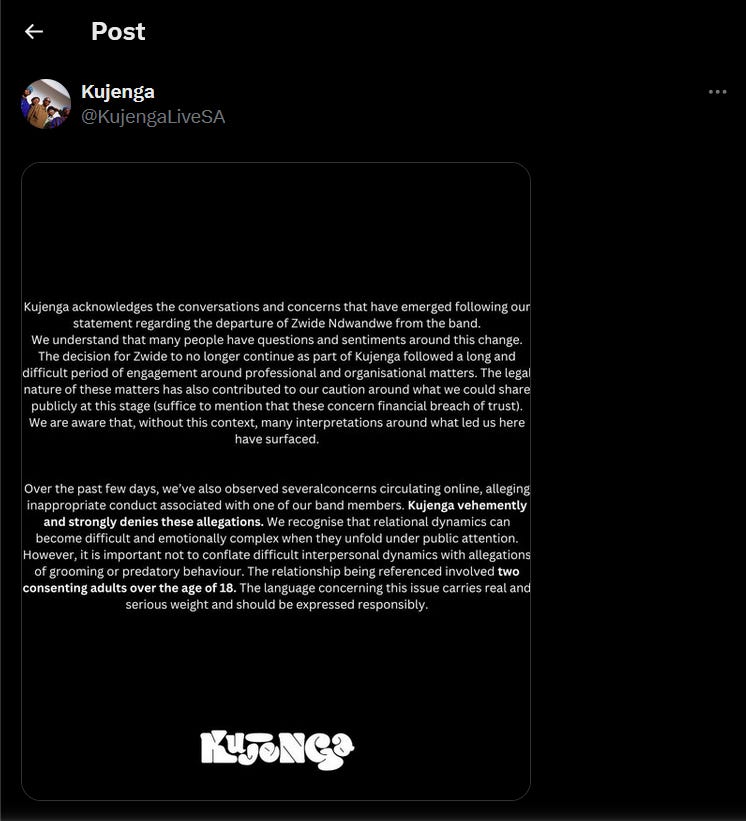
Honestly, fuck Kujenga.
Not because Black art does not matter. Not because jazz does not matter. Not because collective cultural projects are disposable. But because I am tired of watching revolutionary aesthetics become camouflage for ordinary dysfunction. I am tired of beautiful language standing in for ethical practice. Tired of politically literate spaces mistaking self-awareness for accountability. Tired of the performance of emotional intelligence masquerading as moral transformation.
There is a particular kind of heartbreak reserved for the collapse of spaces you once believed were gentler than the world outside them. Not perfect. Not pure. Just softer. More thoughtful. Less violent. And perhaps that is why this entire Kujenga moment feels so emotionally disorienting to many people.
And perhaps that is the real heartbreak of this moment.
Not merely the allegations.
Not merely the fallout.
Not merely the carefully worded statements circulating online.
The heartbreak is the collapse of a fantasy many of us desperately wanted to believe.
Because Kujenga did not simply make music. They represented an idea. A generation of Black South Africans, exhausted by the vulgarity of hyper-commercial culture and the violence of conventional masculinity, projected onto them the possibility of another social imagination: thoughtful Black artistry, softness, experimentation, political consciousness, emotional depth, collective care.
They became shorthand for a gentler future.
But perhaps we should have been more suspicious from the beginning of how quickly aesthetics were allowed to substitute for ethics.
Because revolutionary language has become socially profitable. There is cultural capital attached to sounding healed, intentional, decolonial, emotionally intelligent, and politically conscious. The performance itself is rewarded long before the practice is verified.
So people learn the choreography.
They learn the books to quote.
The politics to reference.
The softness to perform.
The curated vulnerability.
The anti-capitalist posture.
The visual language of artistic seriousness.
But aesthetics are easy.
Ethics are expensive.
And that is the danger of contemporary progressive spaces: liberation can become atmosphere instead of practice. Words like “community,” “healing,” “safety,” and “intentionality” stop functioning as ethical demands and instead become branding material, mood lighting for ordinary human contradictions.
The problem is not that progressiveness is fake.
The problem is that progressiveness can be aestheticised.
And once politics becomes aesthetic, entire communities can participate in maintaining the illusion.
What has become increasingly visible in this moment is how politically conscious spaces sometimes struggle when their ethical vocabulary is forced to confront interpersonal harm. The language of abolition, healing, community, and non-carceral justice can become deeply unstable when people are no longer discussing theory, but responding to the emotional realities of hurt, power, trust, and accountability in real time.
It is important here not to flatten Kujenga into a simplistic story about men. Kujenga is not composed only of men. There are women within the collective too, artists, collaborators, creatives, people equally invested in the vision and cultural meaning of the project.
Which is precisely why this moment matters beyond individual personalities.
Because it reveals how entire cultural ecosystems can become emotionally attached to the image of themselves as morally evolved. Audiences participate in this too. Fans romanticise spaces they desperately need to believe are different from the violence outside them. Writers mythologise them. Social media amplifies them. Everyone begins confusing symbolic progressiveness with ethical coherence.
But symbols cannot protect people.
A jazz collective is not inherently safe.
A politically literate room is not inherently accountable.
A decolonial vocabulary does not immunise anyone from reproducing harm.
And South Africa is particularly vulnerable to this confusion because we are obsessed with symbolic politics. We often mistake vocabulary for transformation. We think awareness is morality. We think softness is safety.
But softness is not safety.
Some people simply replace aggression with performance. They become emotionally articulate without becoming emotionally responsible. They learn to narrate vulnerability beautifully while remaining evasive when accountability becomes uncomfortable.
Patriarchy adapts.
Power adapts.
Ego adapts.
Sometimes domination arrives loudly.
Sometimes it arrives dressed in vintage clothing, carrying a saxophone, quoting Baldwin, and speaking gently about healing.
That is what makes this moment feel so emotionally destabilising to many people. Not because audiences expected perfection, but because they expected congruence.
If you build your entire cultural identity around revolutionary consciousness, people will eventually ask whether the revolution reached your private conduct too.
And what frustrates me about the public discourse is how quickly it collapses into binaries. Some people want to protect the institution at all costs because Black artistic spaces are fragile. Others want immediate annihilation because social media increasingly understands justice through spectacle and punishment.
But neither instinct is sufficient.
The first turns accountability into betrayal.
The second turns justice into performance.
What is actually required is a far more difficult conversation about power inside supposedly progressive spaces.
Because power does not disappear simply because a room contains jazz instead of amapiano. Misogyny does not evaporate because someone reads Fanon. Emotional harm does not become impossible because people use words like “collective” and “liberation.”
In fact, progressive spaces can sometimes become more dangerous precisely because people lower their guard there. Ideological alignment creates emotional trust before ethical trust has actually been earned.
And perhaps that is the deepest tragedy underneath all of this.
Many people wanted Kujenga to represent proof that another kind of Black sociality was possible. A softer one. A more thoughtful one. A more ethical one.
Maybe that possibility still exists.
But no aesthetic, no matter how beautiful, can substitute for the daily discipline of accountability, honesty, responsibility, and care.
Liberation is not a mood.
It is not branding.
It is not a playlist.
It is not an outfit.
It is not political vocabulary performed beautifully enough to sound convincing.
Liberation is practice.
And practice reveals itself not in public performances of consciousness, but in how people behave when there are no audiences, no stage lights, no album covers, no carefully curated captions, no applause.
Just people.
Power.
Intimacy.
Responsibility.
That is where politics becomes real.
And perhaps that is the uncomfortable lesson sitting underneath this entire cultural moment: we built mythologies around alternative Black artistic spaces because we were starving for gentleness in a violent society.
We wanted these spaces to save us from the world outside.
Harm can speak beautifully.
Harm can be politically literate.
Harm can absolutely improvise over jazz.
Hai, uyi bhale kakuhle, Bophelo👏🏾… Exactly this.
This one is personal shame 😭💔